
Economic sanctions are often presented as the middle ground between diplomacy and war. Governments use them to respond to military aggression, terrorism, corruption, nuclear proliferation, and human-rights abuses without resorting to armed force.
The argument is attractive: instead of sending soldiers, impose financial and economic consequences. But sanctions raise an uncomfortable question: Who actually bears those consequences?
A sanction may be legally binding on a bank or company while still being open to legitimate debate regarding its effectiveness, proportionality, and morality. These questions should not be confused.
WHAT ARE SANCTIONS SUPPOSED TO ACHIEVE?
Sanctions are instruments of economic coercion. Their basic logic is:
economic pressure → political pressure → behavioural change.
They can include asset freezes, travel bans, restrictions on banking, trade and investment, export controls and limitations on access to technology or international financial markets.
The problem is that imposing economic damage and achieving a political objective are not the same thing.
If sanctions severely damage a country's economy but its government does not change the behaviour that prompted them, have the sanctions succeeded?
Economically, they had an effect. Politically, perhaps not.
Even the U.S. Department of the Treasury recognizes this distinction. Its 2021 sanctions review recommended that sanctions be connected to clear policy objectives, form part of a broader strategy, consider economic and humanitarian consequences and, where possible, be reversible. Treasury also emphasized multilateral coordination and the need to mitigate unintended harm to populations.
In other words, creating economic pain should not itself be confused with achieving a policy objective.
DO SANCTIONS ACTUALLY WORK?
There is no universally accepted success rate. One influential body of research classified approximately 34% of historical sanctions episodes as successful. Critics applying stricter definitions argued that the real success rate could be dramatically lower. More recent research has produced higher estimates, illustrating just how much depends on what researchers define as "success."
A 2025 meta-analysis of decades of sanctions research concluded that there remains no consensus about even the direction and magnitude of several important factors thought to determine sanctions success.
What seems clearer is that sanctions have a better chance of working when their objectives are relatively limited and realistic. Demanding a specific concession is fundamentally different from expecting economic pressure to cause regime change or completely transform a state's geopolitical behaviour. Sanctions can also produce adaptation rather than surrender.
Governments develop alternative trading relationships, payment systems and supply chains. Sanctioned businesses use intermediaries. New political and economic alliances emerge. Domestic industries substitute for imports.
The result can therefore become:
economic pressure → civilian hardship → sanctions circumvention → alternative markets → government remains in power.
The sanctions have undoubtedly had an effect, but not necessarily the intended one.
WHO ACTUALLY PAYS?
This is where the moral question becomes more difficult. Consider broad restrictions on a country's banking and international trade. Senior government officials may continue receiving salaries. Political elites may retain access to state resources. Military and security organizations may receive priority access to scarce goods.
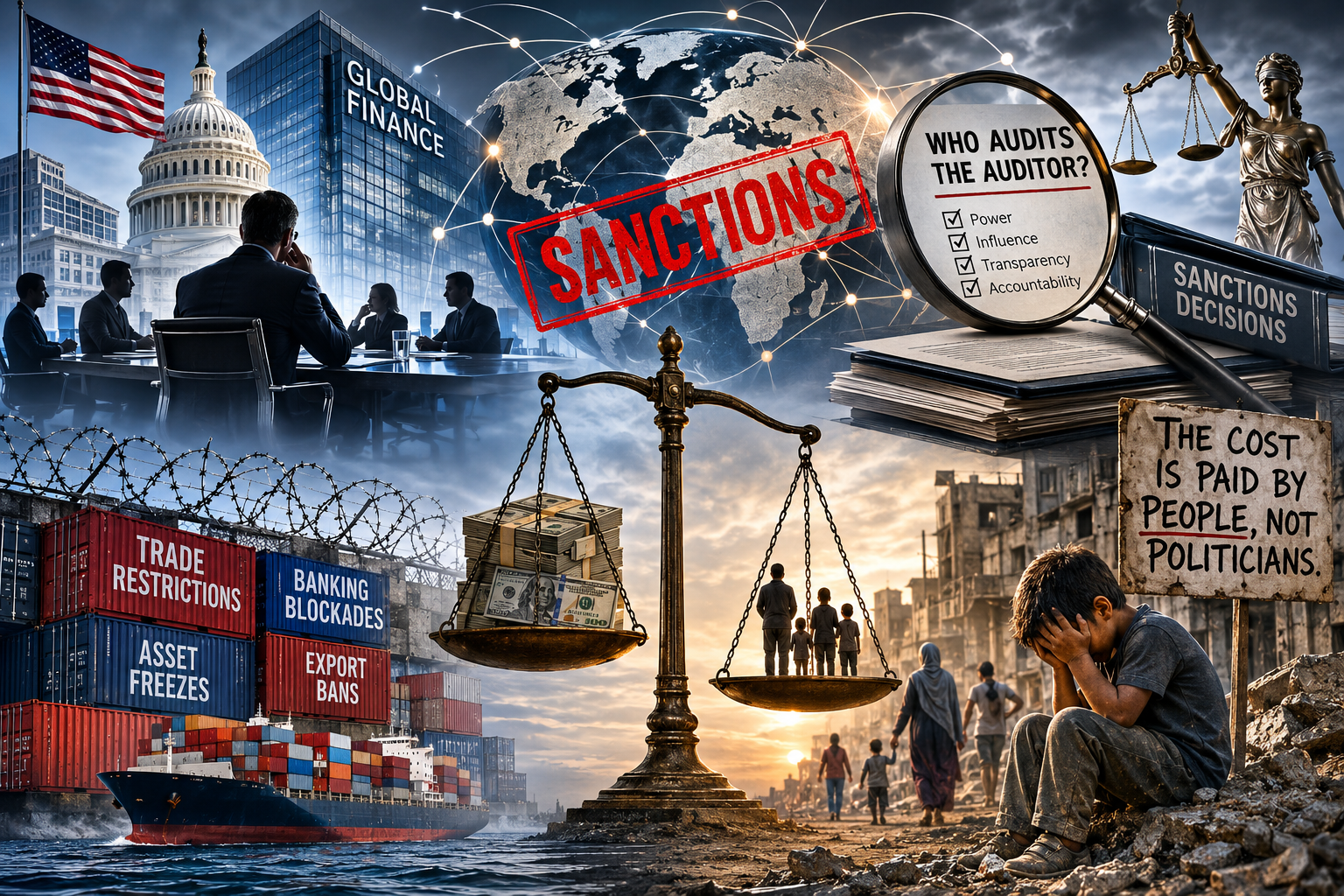
Ordinary people have fewer protections. Businesses may struggle to pay suppliers. Imported goods become more expensive. Currency depreciation reduces household purchasing power. Investment falls, and employment opportunities disappear.
The people experiencing those consequences may have had no influence whatsoever over the government's behaviour that triggered the sanctions.
This creates a fundamental ethical problem:
To what extent is it morally acceptable to deliberately impose economic hardship on a population in the hope that the resulting pressure will cause its government to change behaviour?
There is no easy answer. The alternative may sometimes be worse. If sanctions can prevent military intervention, restrict terrorism financing or reduce access to weapons, significant economic pressure may be defensible.
MODERN SANCTIONS REGIMES FREQUENTLY CONTAIN HUMANITARIAN EXEMPTIONS
But describing sanctions as "peaceful" simply because no weapon is fired understates their potential human consequences.
"But food and medicine are exempt"
The United Nations Security Council, for example, adopted Resolution 2664 in 2022 establishing a standing humanitarian exemption to certain United Nations asset-freeze measures. The resolution expressly recognized the importance of ensuring that sanctions do not obstruct humanitarian assistance and activities supporting basic human needs.
The United States has similarly expanded humanitarian authorizations covering activities including health services, disaster relief, agricultural commodities, medicine and medical devices. But legal permission does not automatically produce practical access.
A company selling medicine still needs a bank willing to process payment. The bank may require a correspondent bank. The shipment may require an insurer, shipping company and other service providers.
Each participant faces sanctions risk. Consequently, organizations may refuse transactions that are technically permitted simply because determining whether they are permissible is expensive or risky. This is overcompliance.
From an individual bank's perspective, refusing the transaction may be rational. From a humanitarian perspective, widespread refusal can undermine the exemption itself. There is therefore an important difference between humanitarian trade being legally permitted, and humanitarian trade actually being possible.
NOT ALL SANCTIONS ARE MORALLY EQUIVALENT
The word "sanctions" covers very different measures.
Freezing the overseas assets of an individual responsible for corruption is fundamentally different from isolating an entire country's banking system.
Restricting access to technology used to manufacture weapons is different from broadly restricting civilian trade. This is why targeted sanctions generally present a stronger proportionality argument than comprehensive economic restrictions.
A meaningful assessment should ask:
Who is being targeted?
What behaviour is supposed to change?
Who actually bears the economic cost?
Is there a realistic connection between that cost and the desired outcome?
Who sanctions the sanctioner?
There is another dimension that deserves attention: power.
The international financial system is not politically neutral. The global importance of the U.S. dollar, American financial institutions, and U.S. correspondent banking gives the United States extraordinary ability to make its sanctions consequential far beyond its own borders. That does not automatically make U.S. sanctions illegitimate.
But it creates an important governance question:
Who audits the auditor?
Who evaluates whether the original justification remains valid?
Who measures unintended civilian harm?
Who determines whether sanctions are actually achieving their objective?
Who decides when they should end?
Domestic sanctions can be subject to legislative oversight, judicial review, and administrative procedures. United Nations sanctions operate within a different international framework. European Union sanctions have their own legal basis and avenues for challenge. These distinctions matter.
A unilateral sanction imposed by one country should not automatically be interpreted as a judgment reached by the international community as a whole. For compliance professionals, this distinction is especially important.
A bank may be legally required to comply with U.S. sanctions because it operates in the United States, uses the U.S. financial system, or conducts transactions subject to U.S. jurisdiction. That establishes a legal obligation. It does not automatically establish a universal moral judgment.
THE PROBLEM OF SELECTIVE MORALITY
Sanctions also suffer from a credibility problem when similar behaviour receives very different responses.
Countries may be sanctioned for human-rights violations, military aggression or authoritarian conduct while strategically important allies accused of serious misconduct continue enjoying extensive trade and diplomatic relationships.
Foreign policy has never been based exclusively on morality. National security, energy, military alliances, economic interests, and geography inevitably influence government decisions. That does not prove that a particular sanction is unjustified. But it makes claims of universal moral authority more difficult.
If sanctions are presented as instruments for defending universal principles, consistency matters. Otherwise, they risk appearing less like neutral enforcement of international norms and more like an extension of geopolitical power.
THE STRONGEST ARGUMENT FOR SANCTIONS
There remains a powerful argument in their favour: What is the alternative?
If a government invades another country, finances terrorism or commits serious atrocities, doing nothing can itself be morally problematic. Diplomatic condemnation may accomplish little. Military intervention can cause enormous destruction and loss of life. Sanctions therefore provide governments with an intermediate instrument.
The relevant comparison should consequently not be: “sanctions = bad” or “sanctions = good”.
The better question is: Which available response has a realistic chance of achieving a legitimate objective while causing the least unnecessary harm?
Sometimes the answer may genuinely be sanctions. But that conclusion should be demonstrated, not assumed.
A REASONABLE MORAL TEST
A defensible sanctions regime should therefore meet several basic conditions. It should pursue a clearly defined and legitimate objective, rather than economic punishment for its own sake. There should be a credible evidentiary basis for imposing it.
The measures should be proportionate to the conduct being addressed. Where possible, consequences should be targeted at responsible individuals, entities and capabilities rather than populations.
Humanitarian exemptions should work in practice as well as on paper. There should be a plausible theory explaining how the sanctions are expected to change behaviour.
The target should have understandable conditions for sanctions relief. And perhaps most importantly, sanctions should be periodically reassessed.
If a policy has inflicted significant economic damage for ten or twenty years without producing its stated objective, continuing it should require renewed justification. Failure should not automatically become the justification for more of the same.
THE COMPLIANCE PROFESSIONAL'S DILEMMA
For compliance professionals, one distinction is particularly important: Sanctioned does not automatically mean criminal.
A sanctions designation can be preventative, administrative, or based on national-security and foreign-policy considerations. It is not necessarily equivalent to a criminal conviction.
Likewise, questioning the morality or effectiveness of sanctions does not justify ignoring applicable sanctions laws.
These are separate matters.
The compliance professional must determine which sanctions legally apply to the institution and ensure compliance with them. Society, academics, courts, legislators and citizens can simultaneously question whether those sanctions are effective, proportionate or morally justified.
Both positions can coexist.
ACCOUNTABLE ECONOMIC POWER
Sanctions are neither inherently moral nor inherently immoral. They are instruments of power. They can freeze criminal assets, restrict terrorism financing, constrain weapons programs and impose meaningful consequences on those responsible for serious misconduct.
They can also damage economies, affect people who had no role in the targeted conduct, encourage overcompliance and remain in place long after their effectiveness becomes questionable.
The real dividing line should therefore not simply be between sanctions and no sanctions. It should be between accountable and unaccountable economic coercion. A sanction should not acquire moral legitimacy merely because a powerful state possesses the legal and financial ability to impose it.
Its legitimacy should depend on its purpose, evidence, proportionality, effectiveness, humanitarian consequences and accountability.
If governments expect financial institutions to identify risks, justify controls, monitor unintended consequences and periodically determine whether their measures remain proportionate, governments exercising economic coercive power should be subject to comparable scrutiny. The ultimate question is therefore broader than: "What did the sanctioned party do?"
We should also be willing to ask:
Who has the power to punish, who actually bears the punishment, whether it achieves anything, and who holds the punisher accountable when it does not?
Sources
Drury, A. C. (1998). Revisiting economic sanctions reconsidered. Journal of Peace Research, 35(4), 497–509.
Egger, P. H., et al. (2024). Analyzing the effects of economic sanctions: Recent theory, data, and quantification. Review of International Economics.
Hufbauer, G. C., Schott, J. J., Elliott, K. A., & Oegg, B. (2007). Economic sanctions reconsidered (3rd ed.). Peterson Institute for International Economics.
Lam, S. L. (1990). Economic sanctions and the success of foreign policy goals: A critical evaluation. Japan and the World Economy, 2(3), 239–248.
U.S. Department of the Treasury. (2021, October 18). The Treasury 2021 sanctions review. U.S. Department of the Treasury.
U.S. Department of the Treasury. (2022, December 20). Treasury implements historic humanitarian sanctions exceptions. U.S. Department of the Treasury.
United Nations Security Council. (2022, December 9). Resolution 2664 (2022), S/RES/2664 (2022). United Nations.
Disclaimer
This article is intended for educational and discussion purposes. It distinguishes the legal obligation to comply with applicable sanctions from the separate questions of their effectiveness, proportionality, and morality. It does not constitute legal advice or advocate non-compliance with applicable sanctions laws.